
Joyce Lathan Woodhouse
1937
“I disagree that all families are like ours. I don’t know many families that are fighting at Thanksgiving. I was very glad that this Thanksgiving was a year that you two were supposed to go to your in-laws. I’m hoping you’ll have some of this out of your system when you come here for Christmas. I would really like a peaceful Christmas. And I love you both"
- Born on July 3, 1937
This memorial website was created in memory of our loved one, Joyce Lathan Woodhouse, born on July 3, 1937. We will remember Joyce forever.
Joyce Lathan Woodhouse's Obituary
Joyce Lathan Woodhouse—who once stepped into a live national television broadcast and, with the simple authority of a mother’s voice, called an entire country back to civility—died after a lifetime defined not only by that famous moment, but by decades of service, leadership, faith, hard work, and devotion to family and the people of North Carolina.
In December 2014, Americans watching C‑SPAN’s Washington Journal witnessed something rare: politics giving way to humanity. As her two sons debated from opposite ends of the political spectrum, a caller from North Carolina was introduced. Moments later came the recognition: “Oh God, it’s Mom.” What followed was not anger, but wisdom—and just enough maternal supervision for a national audience. “I don’t know many families that are fighting at Thanksgiving,” she said. “I’m hoping you'll have some of this out of your system when you come here for Christmas. I would really like a peaceful Christmas, and I love you both.”
That brief, unscripted call became a national sensation. The moment resonated far beyond politics because it reflected something universally understood: family, love, and the hope that disagreement need not destroy relationships. Though the call lasted only minutes, its message endured.
The attention that followed eventually led to an invitation for Joyce and her sons to attend the White House Correspondents’ Dinner as guests of C‑SPAN. To those who knew her, however, the national spotlight merely confirmed what they already knew: Joyce had been keeping people grounded long before television cameras arrived.
Joyce was born in the Roughedge community of Union County, North Carolina, during one of the Roosevelt administrations—a detail she insisted needed no updating. Raised on a farm, she developed a lifelong respect for hard work, agriculture, and community. She graduated from Prospect High School and later earned a Bachelor of Science degree in Business Education from Pfeiffer College.
At Pfeiffer, she developed a lifelong passion for politics and public service while serving as chair of the College Democrats. There she met future Governor and U.S. Senator Terry Sanford, who would become both a professional mentor and lifelong friend.
A simple double date outside Misenheimer changed the course of two families. Two brothers, Ed and Wilson Woodhouse, had planned an evening with Joyce Lathan and Betty Ann Smith. Fate—and, as Joyce would have said, the good Lord—intervened when the ladies sat in different seats than expected in an old Chevrolet. The result was two marriages, six children, and seventeen grandchildren. Joyce and Betty Ann remained far more than sisters‑in‑law; they were cherished friends for life.
Joyce began her public-service career helping elect Terry Sanford governor and later served as a key administrator in his office. She helped keep the Governor on schedule, the office functioning efficiently, and occasionally helped watch the Sanford children as well. Her work earned extraordinary praise, with one newspaper observing that “the nicest thing that has happened in the ancient state capitol building … has been the addition of Joyce Lathan.”
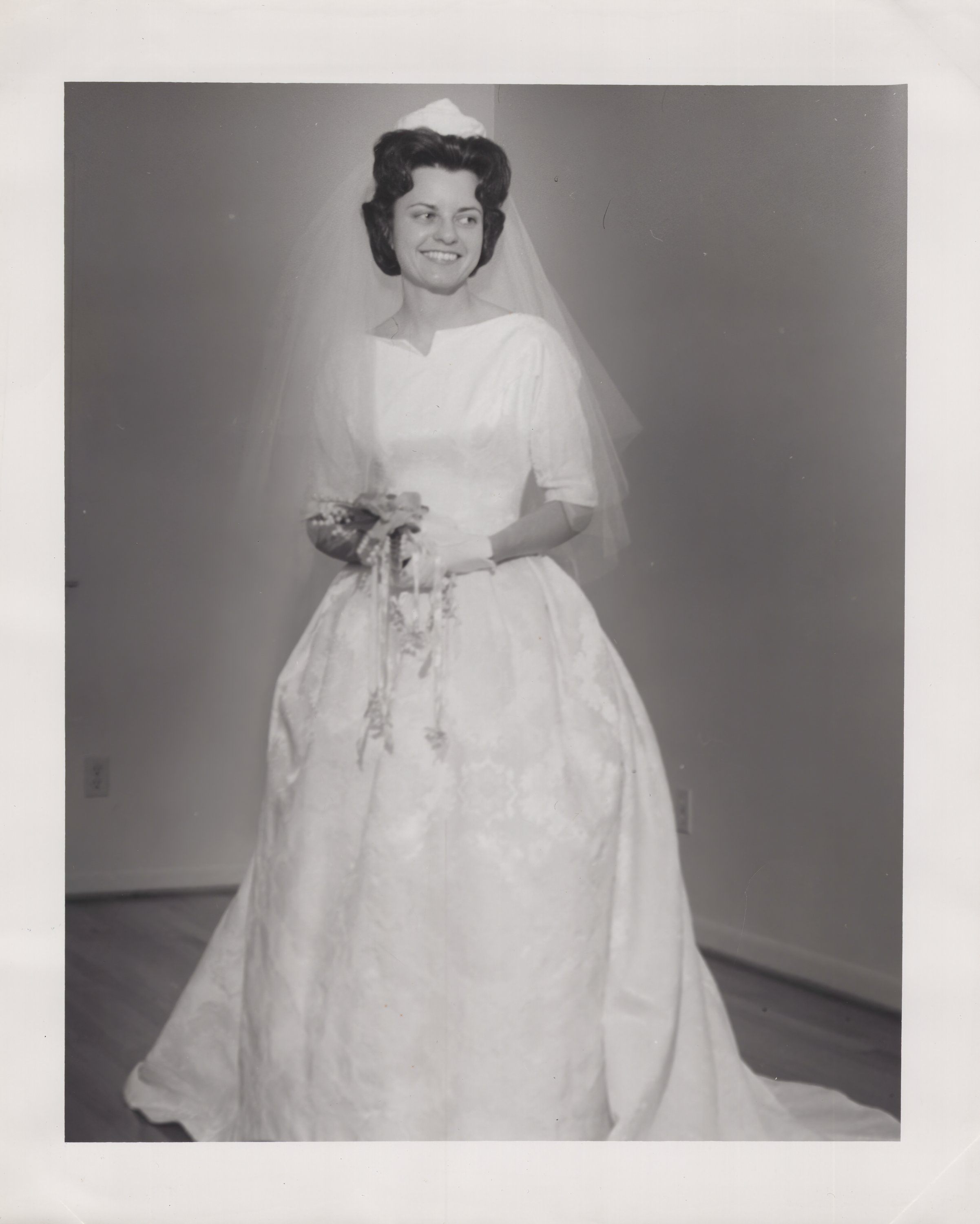
In December 1963, Joyce and Wilson were married at Bethlehem United Methodist Church in Raleigh. Governor Sanford hosted the reception at the Executive Mansion. Their friendship with the Sanford family endured throughout Joyce’s life. When she retired from teaching in 1991 after three decades of public service, Senator Sanford surprised her by delivering the keynote address at her retirement celebration.
After leaving the Governor’s Office, Joyce devoted twenty‑six years to educating students at Cary High School. She taught typing and business courses and led cooperative education programs that helped students transition successfully into the workforce. Generations of students benefited from her high standards, steady encouragement, and unwavering belief in practical education. One of her students was so inspired by her that she made a point of attending her July 3rd, 2026, birthday celebration some 54 years after they were in the classroom together.
Joyce and Wilson built a family that became the center of her life. They welcomed daughter Joy in 1965, followed by Brad in 1967 and, much later, Dallas—whom she affectionately referred to as her “postscript.” Her children aspired to live by the values she taught: faith, hard work, respect, passion, perseverance, and humor.
Few people worked harder than Joyce and Wilson Woodhouse. While teaching, Joyce also became Executive Director of the North Carolina Corn Growers Association, a position she held for nearly three decades. She likewise managed the North Carolina Small Grain Growers Association and helped support the family business, School News Service.
Through tireless effort, Joyce and opportunities, education, travel, and treasured family memories for their three children and eight grandchildren.
As a leading advocate for North Carolina agriculture, Joyce traveled across the United States and internationally, including visits to China, promoting opportunities for North Carolina farmers and strengthening agricultural relationships that benefited communities back home.
In 1979, a chance encounter led Wilson to bring home a Nicaraguan mother and child who had fled political upheaval. Joyce did not hesitate. She fed them, cared for them, and helped them build a new life. Over time, additional young refugees came through the Woodhouse home. Joyce and Wilson opened their doors, helped secure support and stability, and served as surrogate parents to many far from home. For numerous students separated from their families, the Woodhouse household became a place of shelter, comfort, and belonging.
Among those whose lives were transformed was Roberto Gomez, who lived with the family for three years, graduated from Broughton High School with honors, and later built a successful career in California. He never forgot Joyce’s kindness. Decades later, when invited to join a virtual birthday greeting, he arrived in Raleigh in person instead. That gesture reflected the lasting impact Joyce had on those fortunate enough to know her.
Joyce was also a devoted supporter of North Carolina State University, particularly its agricultural programs and athletic teams. The Wolfpack’s 1983 NCAA basketball championship remained one of her favorite memories, and she took special pride in seeing both Joy and Dallas earn graduate degrees from N.C. State.
A faithful member of Brooks Avenue Church of Christ, Joyce quietly supported programs serving children with special needs. Her service reflected her belief in dignity, compassion, and opportunity for every child.
Even after her moment of fame, Joyce remained focused on what mattered most. She often observed that her sons were “both very passionate about what they believe in,” while reminding them that conviction must always be balanced by respect. She frequently described her daughter Joy, whose life has been devoted to caring for a special‑needs son, as her personal hero.
Joyce’s life reflected the same lesson she shared with America during her famous phone call: people can disagree without losing their humanity; family is stronger than politics; and service to others is the true measure of a life well lived.
Joyce was preceded in death by her husband of thirty‑five years, Wilson W. Woodhouse, who died in 1999, and by her three sisters and brother.
She is survived by her three children and eight grandchildren: Joy Hart and her husband Daniel of Pottstown, Pennsylvania, and their children Brad, Christopher, Harrison, and Allison Hart;
Brad Woodhouse and his wife Jessica Carter of Washington, D.C., and their children Brady and Taylor Woodhouse;
Dallas Woodhouse and his wife Christine of Raleigh, North Carolina, and their children Jackson and Cooper Woodhouse.
Tributes & Condolences
Leave a message of support or light a candle
No tributes yet. Be the first to leave a message.